


Frequently bought together:
Description
Descriptions.
Suitable for starting current below 80A, power 135W below the drill. (with balance) 3S 12.6V 40A lithium battery protection board (comes with recovery function-AUTO Recovery)
Scope: Nominal voltage of 3.6V, 3.7V lithium battery (including 18650,26650, polymer lithium battery)
Product Size: 41 * 60 * 3.4mm
Product weight: 9.8g
Charging voltage: 12.6V - 13.6V
Continuous discharge current (upper limit): 40A (if the cooling environment is not good, please reduce the load current use)
Continuous charge current (upper limit): 20A
Note 1: The successful start of the drill requires three 15C-20C power battery, or six 10C-15C power battery (ordinary 18650 cannot start the drill!!).
Note 2: Strictly according to map wiring 0V, 4.2V, 8.4V, 12.6V, do not deliberately short circuit.
Note 3: When soldering the battery for the first time or while charging, as long as the single battery exceeds 4.2V, the "430" resistor will heat up and discharge (discharge to about 4.19V to stop heating). If the "430" resistor is severely hot, check if the wrong line is connected.
For some of the poor basis of electronic customers to explain:
Balanced charge is only auxiliary functions, try not to put a good battery and poor battery mixed together! 3 sets of battery capacity / resistance closer to the better! (2 good battery +1 Poor battery use effect = 3 poor battery use effect).
| Project | Min. | Typ. | Max. | Units | Notes |
| Consuming current | 12 | 18 | 24 | uA | |
| Overcharge protection voltage | 4.2 | 4.25 | 4.3 | V | |
| Balanced starting voltage | 4.17 | 4.2 | 4.23 | V | Balanced version |
| Equilibrium current | 95 | 100 | 105 | mA | Balanced version |
| Balanced heating power | 1.17 | 1.29 | 1.43 | W | Balanced version |
| Overcharge recovery voltage | 4.1 | 4.15 | 4.2 | V | |
| Over-discharge protection voltage | 2.4 | 2.5 | 2.6 | V | |
| Overvoltage protection after over-discharge protection | 2.8 | 3 | 3.2 | V | 1C discharge |
| Overvoltage protection after over-discharge protection | 3.2 | 3.5 | 3.8 | V | 2C discharge |
| Over-discharge recovery voltage | 2.9 | 3.2 | 3.3 | V | |
| Conduction internal resistance | 2.5 | 3 | 3.5 | mQ | |
| Overcurrent protection current | 70 | 80 | 90 | A | |
| Overcurrent delay time | 100 | 150 | 200 | ms | |
| Continuous operating current | 0 | 40 | 40 | A | Resistive load |
| Continuous output power | 0 | 504 | 504 | W | Resistive load |
| Ambient temperature | -40 | 25 | 85 | °C |
| Troubleshooting: | ||
| Fault phenomenon | Fault check and cause | Approach |
| Unable to charge |
Measure the voltage of the three groups of batteries. When one of the battery voltages exceeds 4.25V, the protection board will activate overcharge protection. |
Pair the battery pack well, do not mix the good battery and the bad battery (normal function) |
| Unable to discharge | Measure the voltage of the three battery packs. When one of the battery voltages is lower than 2.7V, the protection board will activate the over- discharge protection. |
Pair the battery pack well, do not mix the good battery and the bad battery (normal function) |
| Charging/discharging failure | OV, 4.2V, S.4V, 12.6V miswired | Rewiring or replacing a new board (human failure) |
| Overcharge/overdischarge failure | OV, 4.2V, 8.4V, 12.6V miswired | Rewiring or replacing a new board (human failure) |
| Discharge protection | Check that the battery pack has sufficient discharge capability and check that the load's starting current exceeds the overcurrent protection current of the protection board. |
Replace the battery pack with a higher discharge capacity, or a protective plate with a larger current (super working range) |
| Component soldering | There is no connection between one of the components and the PCB pad. |
Repair welding |
| Component welding | There is a short circuit between two or more pins of the component. |
Remove the component and re-weld |
| Electrostatic breakdown A | In the unpowered state, measure the G, D, and S poles of the MOSFET. If the forward and reverse resistances of any two pins are 0Q, it indicates that it has broken down. |
Remove the replacement MOS tube |
| Electrostatic breakdown B | Remove the MOS tube and measure the resistance of the G and D, G and S poles of the MOS tube. If there is a resistance indicating that it has broken down, the resistance should be infinite. |
Remove the replacement MOS tube |
Package includes:
1 x Battery Protection Board


Related Products
Related Products


18650 BMS Board 3S 25A Balanced 12.6V
diymore
KES500.00
Descriptions.
Suitable for starting current below 80A, power 135W below the drill. (with balance) 3S 12.6V 40A lithium battery protection board (comes with recovery function-AUTO Recovery)
Scope:...


3S 20A Li-ion Battery 18650 BMS Board 12.6V
diymore
KES400.00
Feature:
Suitable range: For nominal voltage 3.6V 3.7V lithium battery(Including 18650,26650, lithium polymer batteries)Product Size: 64mmx20mmx3.4mm<

18650 BMS Board 4S 40A Balanced 16.8V
diymore
KES500.00
Feature:4 string 16.8V 40A lithium battery protection board (comes with recovery function-AUTO Recovery)
Scope: Nominal voltage of 3.6V, 3.7V lithium battery (including 18650,26650, polymer lithium...

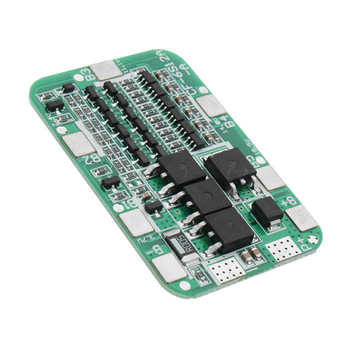
18650 BMS Board 6S 15A Balanced 24V
diymore
KES600.00
Feature:6 string 22V power tools solar lighting, 18650 dedicated, three yuan 3.7V lithium battery protection board, BMS protection board.Battery protection board, as the name suggests battery...
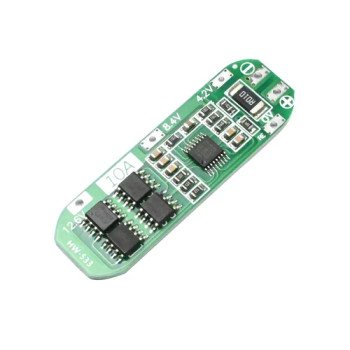
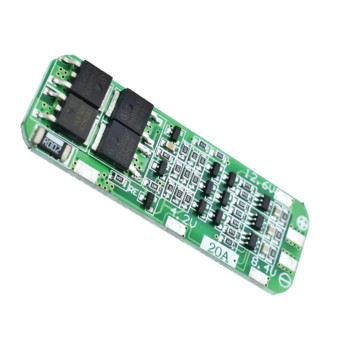
3S BMS 12V 20A 11.1V - 12.6V 6 Cell 18650 Lithium Battery Charging Protection Board Battery Management System Module
diymore
KES300.00
3Cell / 3S 11.1V 10A Battery Management System / BMS Over Voltage, Over Current, Short Circuit Protection Module for Lithium ION or Lithium Polymer (LiPO) Batteries.
Features:
Short c